History Rhymes: 1996 Telecommunications Act and Artificial Intelligence
by Reed Hundt [1]
At the beginning of the 90s the only cell phone you could buy was a big analog device that cost up to $3000 in 1990. Adjusting for inflation, that’s $6000 in today’s money. If you take that money to an Apple store you can buy at an Apple store all of the following: a MacBook Air, an iPhone 17, an iPad Air, an Apple Watch, and AirPods. You would have about $3000 (minus tax) left over.
This consumer cornucopia from the 1990s to now is reflected in the comparison of the most valuable public companies between then and now:
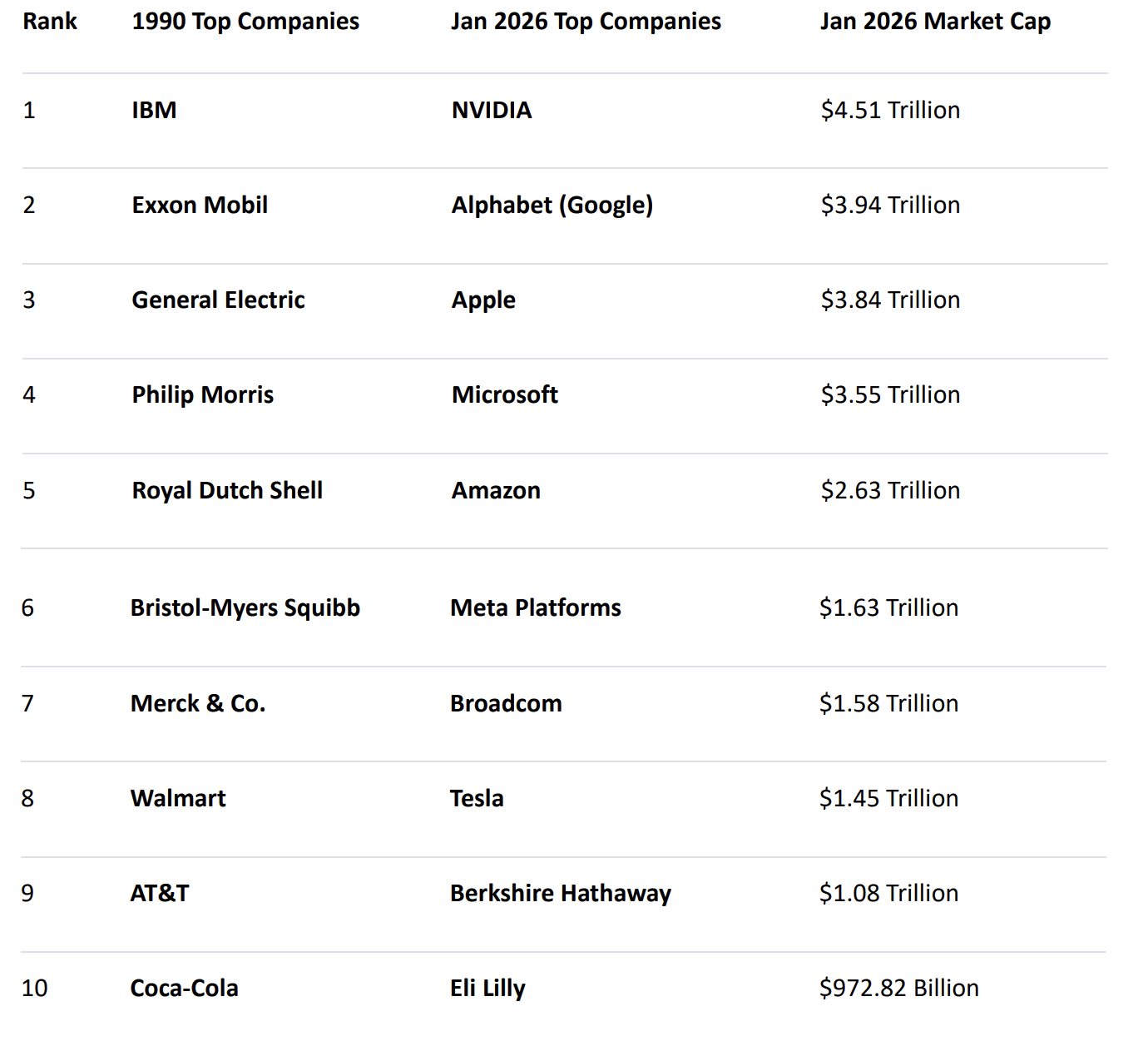
The top seven firms now all come from the communications technology revolution jumpstarted in the 1990s. Their values are staggering because they sell highly desired goods and services that reach deep into American society and broadly around the planet. They shape human perception of reality and affect the nature of consciousness.
Of course, the American government did not invent the products sold by these firms or finance the businesses. But three decades ago, it did choose a strategy aimed at enabling innovators and investors to produce these outcomes.
The legislative tentpole of that strategy was the 1996 Telecommunications Act, passed by Congress on January 3 and signed by President Bill Clinton on February 8, 1996, saying it would “bring the future to our doorstep.”
Clinton signed the law digitally, in the Library of Congress. The White House selected a venue and a method intended to depict what was happening. The United States adopted a rule of law for communications technologies that moved from the tightly regulated analog world of Bell companies, network-dominated broadcast tv and radio to a largely deregulated digital platform that fused computing and communications. The tactics included legislation, regulation, antitrust policy, multi-lateral agreements, and a record-breaking spending investment in every classroom and library in the United States.
This essay will describe how the national government's strategy three decades ago led to the global information environment of today. This will show that humans can use the power of government to do more good than harm. They can win and deserve the trust of the people they are sworn to serve.
It is also intended to explain why the lessons of the grand strategy adopted for digital communications three decades ago suggest it is time to create an Artificial Intelligence Commission. This agency should report to Congress and the Executive Branch, work with state governments, and transparently engage with the nonprofit and for-profit sectors where massive talent is already dedicated pushing to the limit the capability of artificial intelligence. This amazing technological breakthrough plainly has immense potential to benefit the United States and humanity, and at the same time could create significant disruption, or worse.
The American people deserve a group of public servants committed to crafting the national government strategy for making the best and avoiding the worst of the effects of this new revolution. It may exceed the significance of the communications technology revolution. It may vastly exceed it. But, as this essay will show, the public will be well served if an agency dedicated to AI did its job as well as the government did in addressing that wave of change thirty years ago. [2]
Objective: one world; everyone everything all at once
The 1996 Act was part of a triptych of statutes that empowered the Federal Communications Commission to reverse the government stance toward the critical telecommunications sector: the 1996 Act, the 1993 Omnibus Budget and Reconciliation Act that authorized the FCC to create the digital cellular industry, and the 1992 Cable Act that created the incentives for satellites to deliver content and the cable industry to take early steps toward becoming broadband providers. Underlying all three laws was the singular premise of reversal of the 1934 Communications Act's commitment to regulating monopolies. Replacing that was the new paradigm: competition, innovation, the merging of computing and communications through digitization, the birth and death of firms, and consumer benefits distributed to everyone not only in the United States but everywhere in the world.
The ideas animating the new strategy had been under development since the 1980s. In that decade Democrats, routed electorally and demoralized by Ronald Reagan's brand of conservatism, began to discuss how to fuse private sector dynamism with government strategy as compellingly demonstrated by Japan. As "Atari Democrats," both Governor Clinton and Congressman, then Senator Gore, were thought leaders in reconceiving the purpose of government.
By the time of their inauguration the Cold War was over, the Soviet Union had collapsed, the bipolar world had turned into globe-circling opportunity, the personal computer was more important than the mainframe, and software was becoming a new common language. The new Administration was sure that technology and capital markets drove history. The Clinton-Gore strategy was for government to enable non-government forces --research and investment, especially relating to computing -- to increase economic growth while assuring that the benefits of growth were shared by everyone in the country and the world.
The Federal Communications Commission was in 1992 not regarded as either a hot place to work or the seedbed of economic growth. The agency occasionally emerged into public view when its chairs commented about broadcast television, the common national medium: "TV is a vast wasteland," said Chairman Newt Minow in 1961, for which he was honored by having the boat on Gilligan's Island named for him. "TV is nothing but a toaster," said Chairman Mark Fowler in 1985, which won him plaudits from libertarian thinktanks, although the 60 million people who watched The Cosby Show (number one at that time) probably disagreed. A chair could also get attention by fining Howard Stern for indecent language [3] (one of the items on the desk when Chair Reed Hundt arrived in 1993.) Otherwise, it implemented technical, arguably boring regulations relating to the interaction of monopolized landline telephony with the long-distance oligopoly of AT&T, MCI, and Sprint. The agency was of limited importance in business, finance or politics. [4]
That changed dramatically in the four years from 1993 to 1997.
During the 1992-93 Presidential transition Gore asked Clinton to give the vice president the "power of the pen" in two areas: communications and environment. The president-elect agreed. He and his wife would focus on fixing the budget deficit and providing health care insurance at affordable cost to everyone. The latter move would bolster the former by lowering health care expenditures by the national government. These two heavy lifts with a Democratic but divided Congress would take all the political savvy the Clintons could muster (not a small amount, but it was important to note that Clinton had not won a majority of the national popular vote and almost immediately upon election suffered many assaults by national media). Gore was, despite his subordinate role, given substantial liberty to shape strategy in his two chosen areas.
The pillars of the Gore strategy were:
--competition among private firms to increase investment, even if that meant building redundant networks;
--government support of new industries generally but not specific companies in these multi- actor industries;
--specific steps to share economic growth with every income class, education level and geographical area in the country;
--demand creation for a skilled workforce, motivating people to go to college, study science, and get smarter.
--inclusion of everyone in the social benefits of access to information.
The strategy was also international. America firms would show the world how digital technology changed operations, created efficiency, and spawned new firms. The American government's laws and regulations would be copied in every country. The world would be wrapped in intelligence, common pursuit of sustainable growth (Gore also had the
environmental portfolio for this reason). Democracy would flourish even in the ashes of the Evil Empire and even in China that had only just rejected Maoism.
The United States government could not order all this change. We were not going to pay for these developments or pick particular firms to be winners. Instead, we would change the rule of law to align technological innovation and investment with the goal of increasing the standard of living of all Americans. That was the plan - some would describe it as "neoliberalism." The term now draws opprobrium from the left and right. To paraphrase Franklin Roosevelt's defense of the Tennessee Valley Authority against political attack, it does not matter what you call it, it worked.
The impulse to make money and the desire to invent are powerful forces. They can be directed toward, to put the matter starkly, good or evil. A society creating wealth through change can have rising inequality or greater equality, hostility of the have-nots toward the haves or a sense of solidarity in a great collective enterprise, disunion or union. We believed that a good strategy and a well-designed rule of law, including regulation and some public spending, would cause investment and invention to produce great results for the United States and the world. For the greater part of the three decades most of what resulted was beneficial. Now a new era of change has opened.
Government should aim to win the trust of the people; the people need government to help make the best of technological revolutions.
Most American people do not trust the government. They do not like either of the two major political parties. They do not believe government provides what they want. No nation is likely to thrive if the national culture rejects and resents the efforts of elected and appointed public official.
The Clinton-Gore Administration confronted the same problem in the 1990s. Since the oil shocks and economic disruption of the 1970s the American people had lost faith in institutions. Our plan was meant to change attitudes toward government for the better in part by making explicit the pact between government and the private sector to do well and to do good at the same time - putting the matter too simply but not incorrectly. The strategy worked, as this chart shows. A quarter-century of declining trust in institutions was reversed.
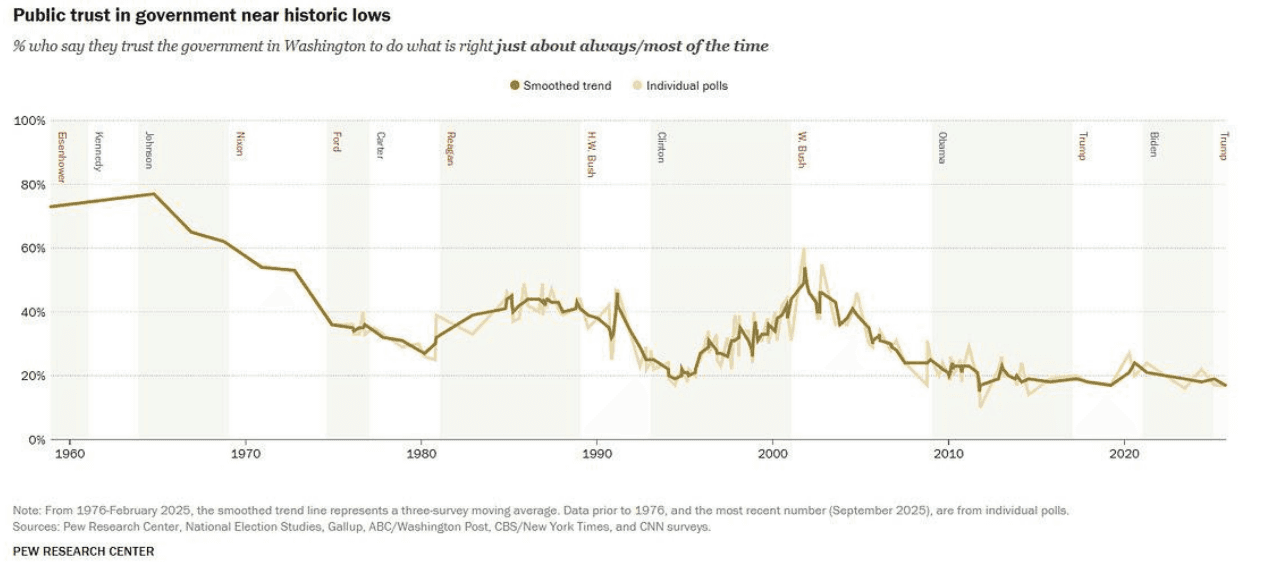
Starting with the response to the economic downturn of 2000-1, running through the ill- fated invasion of Iraq, the financial crisis of September 2008, and into the present that trust has again eroded. If the current national government strategy is rebuilding it, the effect may be confined to large fraction of the country that is the political base of the Administration.
This is not a good harbinger for the survival of the American experiment. Addressing AI is critical to rebuilding trust in American government.
Our communications technology revolution and AI also both are global in dimension. In the 1990s the American government and business sector face a world of opportunity. The Cold War was over. Communism had lost. The Soviet Union had collapsed and all the countries
in the Soviet bloc were available for investment. China too had rejected Mao and was ready for capitalism, if not democracy. Our strategy necessarily aimed at persuading the whole world to adopt our new rule of law for communications technology. Success globally for American businesses would then follow.
China is not the same country anymore, of course. It has created its own distinctive Internet economy. It is building its own AI sector. But leaving global AI opportunity for Chinese firms does not seem the best way to succeed for the American AI firms. The AI strategy for government now, just as in the 1990s, should be global.
The American people must support a government strategy for it to succeed. Public opinion is everything. This was true for us in the 1990s and is true as to AI now. These questions were the same for us as they are for government now:
--Will technological innovation make everyone better off in the United States, or only some better off and a few much, much richer?
--Is the innovation going to lead to better and more jobs or fewer and worse work for most people?
--Is there going to be any reason to go to college, learn new things, if the new jobs and new skills are not being taught in higher education?
--What outputs will grow in scale and scope, and are they intrinsically good for humanity?
Now, more than was the case in the 1990s, there is the ultimate question: Will this technology replace us? To some degree all technologies have reduced the role of humans in changing the world. Will this one take humans out of the equation?
Every major technological shift raises the issues of trust in government, global impact and the well-being of the people. Eventually government responds with legislation and regulation to address these topics.
The goal of government action might be to share benefits among those who appear left out (like the idea of requiring telephone companies to offer service "universally," which means to every household). Or it may be to alter the direction of change (like support or opposition to renewable power). It can be, too, the recovery of the economy after the economic bust that follows the technology-driven boom. With these or other purposes, one or more agencies are likely to be created or used to put the government response into effect through regulations.
The railroad expansion in the United States busted in the Panic of 1873. The continent-spanning railroads are still used today, but the economic collapse led to populism, the great railroad worker strike of 1877, and decades of worker unrest. It contributed to the national
government's surrender to the Southern white insistence on ending Reconstruction. And on the regulatory front, in 1887 the Interstate Commerce Commission was formed.
Radio and electrification of households drove the boom of the Roaring 1920s. The darling of the stock market, the radio company RCA, went from $1.50 a share in 1921 to $549 in 1929. It lost 97% of its value by 1932 and did not recover completely for three decades. Now you have to be very old to have heard of it. The bust created a decade of Depression, and enabled fascism to take over democracies, led to the Second World War - and the creation of the Federal Communications Commission to make sure that at least the national telephone company, AT&T, would not fly high, then crash like RCA. The FCC of course was only one of many agencies created in response to the Great Depression.
The year after the atomic bombs were dropped on Japan the United States formed the Atomic Energy Commission. Partly in response to the Arab states exercising more control over oil supply and price, the Energy Reorganization Act of 1974 replaced the AEC with the Nuclear Regulatory Commission. That agency did not prevent the 1979 Three Mile Island accident or the bankruptcy of the venerable Westinghouse Electric Company because of cost overruns on nuclear power plants. Its mixed track record does not alter the fact that this technological revolution too caused an expert agency to be created.
Currently, the national government strategy for artificial intelligence is to consider banning state regulation. What is needed is an Artificial Intelligence Commission. The public deserves an institution dedicated to serving the public interest as this new technological revolution changes the world yet again.
In the 1990s, as the communications technology revolution was taking shape, the FCC was available for the same mission. It had to change operationally and be given new authorities, but it did its job. No such governmental institution appears available to address AI. Indeed, at present, the government's recent downsizing has left it less prepared to assemble, or recruit, the talent it needs for a number of purposes.
To address the question of what an Artificial Intelligence Commission might be charged to do, let us go back three decades to review the role the national government and its expert agency, the Federal Communications Commission, played with respect to the communications technology revolution.
Abraham Lincoln said, "The legitimate object of government is to do for the community of people whatever they need to have done, but cannot do at all, or cannot so well do, for themselves in their separate individual capacities." Faced with the intimidating complexities and mysterious capabilities of AI, nearly everyone would admit to being baffled and buffaloed. Surely government needs to "do for the community of people whatever they need to have done" about this technology revolution. That was the role assumed by government in the salad days of the communications revolution.
1993: Strategy Formation and Legislative Authority
During 1993 Al Gore convened every week or every other week a working group to develop the technology strategy. Reed Hundt, awaiting confirmation as FCC chair (which did not occur until November), was a member along with future Nobel Prize winner Joe Stiglitz, antitrust division head Anne Bingaman, Gore staffer Greg Simon. The Vice President selected the themes and explained his strategic goals. The group debated the objectives and the tactics. The overriding theme was that one network would be built to everyone in the United States, and then the world. Everyone would be connected to everyone at very low cost. All information – everything humanity had ever learned --would be put in digital form and shared on this network. After much discussion, the Vice President decided that this “information superhighway” would be the Internet. [5]
In August 1993 the Clinton budget was adopted with the tie breaking senate vote cast by Vice President Gore. That Omnibus Budget and Reconciliation Act contained the instruction to the FCC to create the digital cellular industry – from scratch. The agency was to decide who got spectrum licenses –electromagnetic frequencies that could be manipulated to carry the ones and zeroes of code at approximately the speed of light just like radio and broadcast TV did for he soon to be relegated to the past analog signals [6]. More than that, not specified in the legislation but authorized by the now ancient 1934 Communications Act and implied in the budget law (OBRA), the agency could decide everything relating to the use of that spectrum.
Also, in 1993 researchers at the University of Illinois in Champaign Urbana released software (called a browser) that enabled anyone with a computer to create a picture on the computer that could be sent to anyone anywhere in the world who was electronically connected to that computer. And the browser enabled the person at the keyboard to look at any other computer's picture. The information had to be sent digitally but the CERN laboratory in Switzerland had a resident genius named Tim Berners-Lee. He invented software that enabled these connected computers to share the information and, sharing the one world vision that was the Clinton-Gore strategic goal, he gave it away for free.
Free software to connect all desktops. All that remained to be provided was a way for the connections to be made. It would be the Internet. That became the "information highway." But the FCC had to make the connections possible, for as many as economically possibly and as fast as possible. No one was to be left behind in the great transformation or unconnected by this world changing technological revolution.
Beyond that, the rest of the planet was to be wrapped by this new network called the Internet. Then as a global community we could solve climate change and every other problem faced by humanity.
In 1993 the FCC, still under old management, had applied the 1992 Cable Act in a way that raised all cable prices. The agency's objective in the do-over rulemaking was to lower the prices the local cable monopolies charged for the same bundle of channels (these are the tiered services now disappearing as consumers instead pay for streaming apps). At the same time, we wanted to create competition for the cable companies while also giving them an incentive to add more channels. This was a daunting task, appropriately delegated to an agency that was beefing up its economic muscles by adding first-rate economists from Berkeley (Michael Katz) and Stanford (Greg Rosston) and promoting talent from within to prominent roles in shaping the rulemaking.
Finally, in 1993 Congress, led by Ed Markey, John Dingell and Rick Boucher in the House and Senators Jay Rockefeller and Fritz Hollings began writing what became the 1996 Act. President Reagan's brilliant, fearless antitrust division head, Bill Baxter, had broken up the AT&T phone monopoly in 1983 - the biggest restructuring of a major company by federal mandate since the breakup of Standard Oil, and until now the last of its kind, as subsequent governments have rarely tried and never succeeded to curtail the expansion of the social media giants or even to divide Intel between foundry and design. Lina Khan tried during her tenure at the helm of the Federal Trade Commission, but both the judicial process and the lack of time stymied her.
From the moment Baxter divided telephony between landline monopolies offering local voice (the seven Baby Bells) and the three long distance firms (AT&T, MCI and Sprint), the Bells wanted to offer long distance. Their own prices were regulated by the states at low rates of return. Long distance was more lucrative, and they could offer it easily with their tangible connection to businesses and residences. They wanted Congress to eliminate the consent decree (the Modified Final Judgement) that had Judge Greene of the District of Columbia deciding all the new businesses they could or could not enter from their monopoly position. AT&T did not believe they could count on the court order to protect their business forever and with a pro-competition Administration and a Congress where they had some influence (as probably the most well-known and one of the most valuable companies in the nation) it was time to make a deal. Congress would let the long-distance companies acquire services, if not assets, from the Bells that would enable them to offer local telephone service. The Bells would have the MFJ cancelled and could enter any business they wanted, including long distance.
This market share swap, each into the other's market, was perhaps more poetic than practical, but it did seem the essence of the new competition paradigm. The FCC would enable the switcheroo by rulemaking that gave each industry a fair chance to take the other's business.
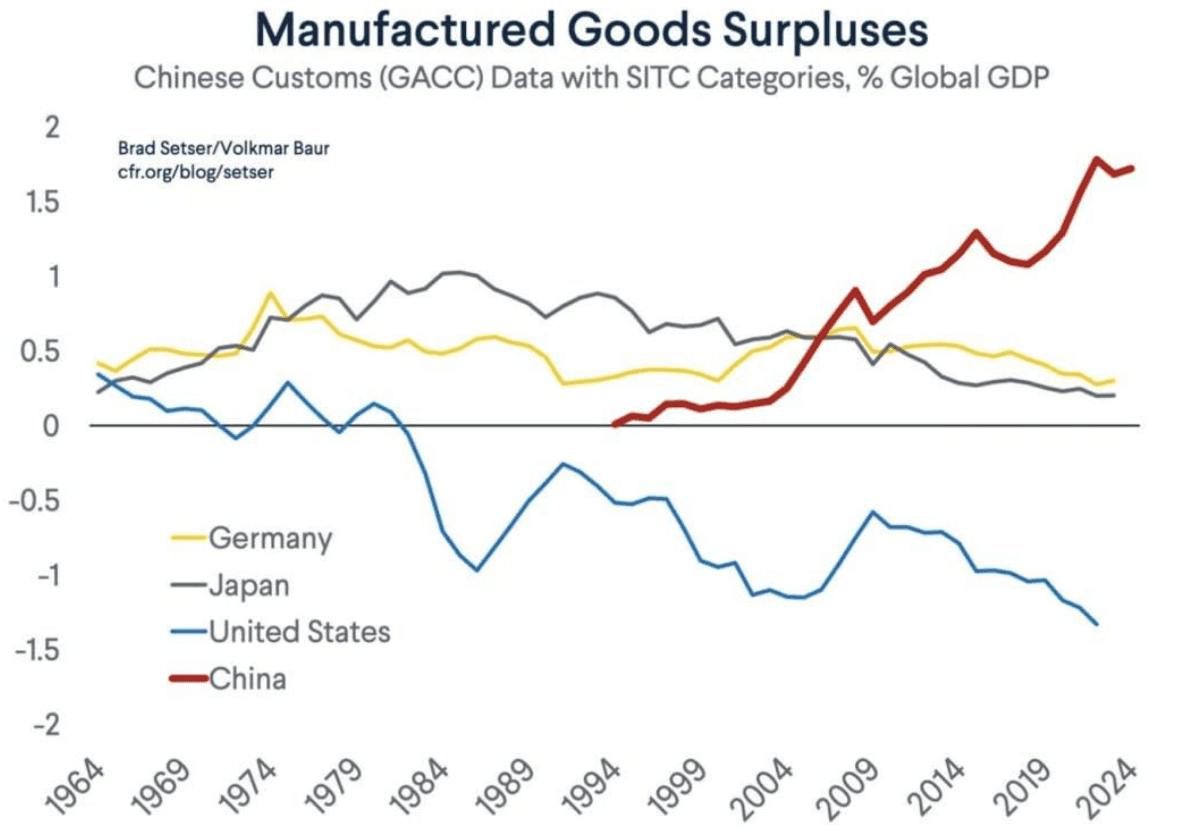
Internationally, the Administration's strategy was to open closed markets in every country, and especially China. At that time China's trade surplus was small, focused in low value goods and, as this chart below shows, not as large as either Germany's or Japan's. Our goal was to open China to high value manufactured goods and services. Indeed, ultimately iPhone sales in China in the next century reflected the success of that plan, although by then the terms of trade had changed.
Trade Ambassador Mickey Kantor and Deputy Trade Ambassador Charlene Barshefsky engaged in vigorous efforts to open Japan. The North American Free Trade Agreement had been signed in December 1992. It took effect on January 1, 1994. The new agenda for the global economy was described in the Marrakesh Agreement of April 1994 established the World Trade Organization, effective at the beginning of 1995.
For the communications and technology agenda the plan was for the United States to show benefits from the new technologies and the new competition paradigm. Other countries would imitate by learning from our successes. They also would be bound by treaty to do so. This in turn meant that if our efforts led to American firms old and new creating new digital services delivered at low cost over any distance, these firms could become global, huge, and dominant in every geographical market.
1994: Wireless, Internet, and International Agendas
By January 1994 we at the Federal Communications Commission had listened enough to experts of all kinds, in business and academe, that we were firmly convinced of certain precepts.
Nick Negroponte of MIT was correct to say that everything now carried on a wire should be wireless and all the video delivered wirelessly should be on a wire. In other words, voice calls should be wireless; television content should be on fiber optic or coaxial cables. We agreed.
In 1991 John Malone, the king of cable, gave a speech at Yale, his alma mater, in which he said that three technologies were going to come together and change the world. They were digitization of information (from waves emulating signals to waves carrying bits), fiber optics carrying that digitized information by and nearly at the speed of light (eliminating distance as a constraint on the transfer of information), and the microprocessor (enabling the decoding of the digitized information at any destination, including a cable box or a computer on a desk). He then said, eureka, we can have 500 channels delivered by cable, with the channels digitized, carried by fiber optics across the country, and downloaded into cable boxes in every house.
He had everything except the idea. The wire - pipe, cable, conduit, all synonyms - would be for the Internet. That's what by the beginning of the next century would be called broadband. And wireless would continually increase its capability to carry more data at a lower price per bit. [7]
And that would lead 13 years later to the introduction of the iPhone, where the I stood for Internet. [8]
All we needed to believe at the FCC we did believe by January 1994. Step One: enable the Internet to be the Information superhighway. Step Two: enable digital cellular to go from zero customers to become as globally ubiquitous as Coca-Cola. Both required electricity, the one for the cell towers and recharging the battery and the other for the cooler. But Coke was already everywhere humans lived and we wanted digital cellular to get just the same reach and be even more desired.
To pursue our agenda we re-organized the agency, creating the Cable Bureau, the Wireless Bureau and the International Bureau. We formed a task force for spectrum auctions, finding economists expert in the abstruse theory that won John Nash the Nobel Prize in 1994. (Russell Crowe played him in the movie, in which the FCC's auctions got a mention. This, our economists said, was better than being in "Gilligan's Island.") We began hiring directly from Harvard Business School (with the help of popular professor Richard Tedlow) and other elite institutions. And we offered buyouts to many senior people in the career ranks, while promoting others who had not been given responsibilities commensurate with their talent. Overall, we lost about 20% of the agency's people and added 400 new people, increasing the size of the agency from 1750 to 2000.
Our international tactical plan came from Peter Cowhey, an information and trade expert from the University of California at San Diego. The FCC presided over an enormous trade imbalance. About $8 billion a year was the difference between money paid to foreign telephone companies for terminating outbound calls compared to money received in the United States for terminating calls. Immigrants calling home; businesses calling foreign branches: these were the outbound calls. The outbound calls cost on a global average 55 cents a minute: a huge number but the lowest in the world because other countries charged high prices through state-owned
or controlled telephone monopolies in effect to tax their own international callers. Multinationals, however, were setting up their own systems to bypass these state-owned firms. The internet was sure to bring its end.
With change inevitable, our strategy was to threaten an immediate FCC order to reduce the price on outbound calls unless other countries did what we asked. We would agree to phase in declining rates over time if counterparty countries allowed fiber optic cables to bring the Internet to their shores, [9] adopted our neutral attitude toward wireless transmissions software standards, regulated telephony transparently, and generally opened their communications markets to global competition.
Charlene Barshefsky loved the professor's idea. She added to it a trade agreement concerning information technology goods and services. These initiatives began in 1994. [10]
In March of that year Al Gore gave the first speech on the vision of the Internet as the global medium of information that any elected leader in the world had given in an international forum. His audience was the international telecommunications union development conference in Buenos Aires.
Domestically, we adopted a multi-prong approach to the Internet.
First, we assured all firms that they could use the local landline telephone line for Internet communication without paying the Bell companies anything. Every phone line actually has two copper wires - the so-called twisted pair. The second, redundant one could be used to send a signal from one computer to another computer. Then that second computer could connect through the same fiber optic network John Malone had talked about in 1991 in theory to everywhere in the world.
But if there were a network anywhere in the United States - and there was one connecting many academic and business institutions - it also could connect to Bell landline connections in every house. That meant that a computer on a desktop in a house in, say, Maryland, could connect on the landline to a network and then through that network to a landline in, say, Arizona. Or Bangladesh, Beijing or even Menem's Buenos Aires.
By assuring PC owners that they could use the local landline for free, we enabled other firms to start businesses connecting those landline internet calls to the national fiber networks. Soon there were up to 5000 local internet access providers in the United States offering dial-up service, the name given to the use of that copper line. Names now forgotten included ClarkNet, XMission, ATMnet. A small company called America On-line had been founded for this purpose in 1983. But the conjunction of the browser, the CERN software, and the FCC's guarantee of non-interference by the Bells expanded their potential market manyfold. Eventually they won the email business as everyone knows from the Tom Hanks-Meg Ryan romcom. [11]
In December 1996 AOL offered unlimited access to the Internet for $19.95 a month. If the Bells had charged for the use of their line, an essential component of the service, they could have raised the price for the consumer to any level. Because under the 1996 Act the Bells looked to offer long distance, and email could substitute for calls, the Bells probably could not have resisted the temptation to use price to slow the spread of the Internet. Even if that had not been their purpose, they had an irresistible opportunity to extract rents from their monopoly ownership of that crucial copper connection.
The telephone companies must have known we would not allow them into long distance if they had slowed the spread of the Internet. They wanted that opportunity. It was their central achievement in the 1996 Act. They did not direct their lobbying armies at our choice to favor the Internet. The information highway was under rapid construction: the Internet spread like wildfire.
We also promoted Internet access firms by allowing them to recover what was called reciprocal compensation (which we relabeled "symmetric" for this purpose). If two telephone firms exchange calls, they net the total volume from time to time and the one that places more calls (hence collects the revenue) pays the other one to create a fifty-fifty share of the business.
Internet access firms received calls only, placed none. Under the balancing regime they got payment from the landline firms that sent them calls. This subsidized Internet access because the Bells set the price high above their cost. To re-balance, they lowered the price over time -
also a good outcome from our perspective.
We decided as a whole government not to regulate the Internet at the FCC or anywhere in government. Neither did we decide simply to ignore the need for rules. In 1998 the United States government gave oversight of the Internet domain name system to a nonprofit called the Internet Corporation for Assigned Names and Numbers. Our goal was a multistakeholder global governance system.
But our most well-known effort eventually proved to be our initiative to provide internet access to every classroom and library in the country. The digitized information/superhighway/ computerized/technology innovation story needed to reach everyone. To deliver on that promise, we at the FCC began in early 1994 to meet with schools and libraries. They built a powerful lobbying force to argue for the E Rate. Fortunately, Congressman Ed Markey chose to champion this initiative. He wrote it into the early draft of what became the 1996 Act. His language gave the FCC the authority to place a charge on a phone bill that the agency could collect and spend on network connections for every classroom and library to the Internet. With that smart move, worked out between Judy Harris and Karen Kornbluh at the FCC and the
Congressman's staff, the funding did not rely on annual appropriations. The FCC itself could raise and spend the money.
The Clinton Administration strategy called for rapid implementation. The American economy is big and the global economy five times bigger. To transform both with results that could be shown by the end of two terms was a daunting task. It was important to demonstrate progress by 1996, or there might not be a second term. At the FCC we needed to conduct spectrum auctions quickly. That was the way to launch the digital cellular component of the strategy.
We held the initial auctions in July 1994, only eight months after the Hundt Commission commenced. From July to November, we conducted auctions of smaller blocs of spectrum. . These were important and complicated processes but only test runs for the big auction that created the market structure and initial firms for digital cellular.
The big one was Auction 4. It was all virtual (no major auctions had ever been conducted online before). It began on December 5, 1994 and closed March 13, 1995: 18 bidders won 99 licenses for $7 billion. [12] We printed up a facsimile of a $7.7 billion check (adding all the auction revenues to date together) on a piece of cardboard about six feet long and three feet high, and presented it to President Clinton and Vice President Gore. Those 18 winners were the first entrants in the race to build the digital cellular industry.
This was the biggest sale of public property in history. Despite our many market-shaping and pro-competitive regulations, this fact alone caused us to be perceived as conservative, even libertarian. That perception was integral to the FCC obtaining the many roles assigned to it by the Act. Speaker Gingrich did not shut down the agency.
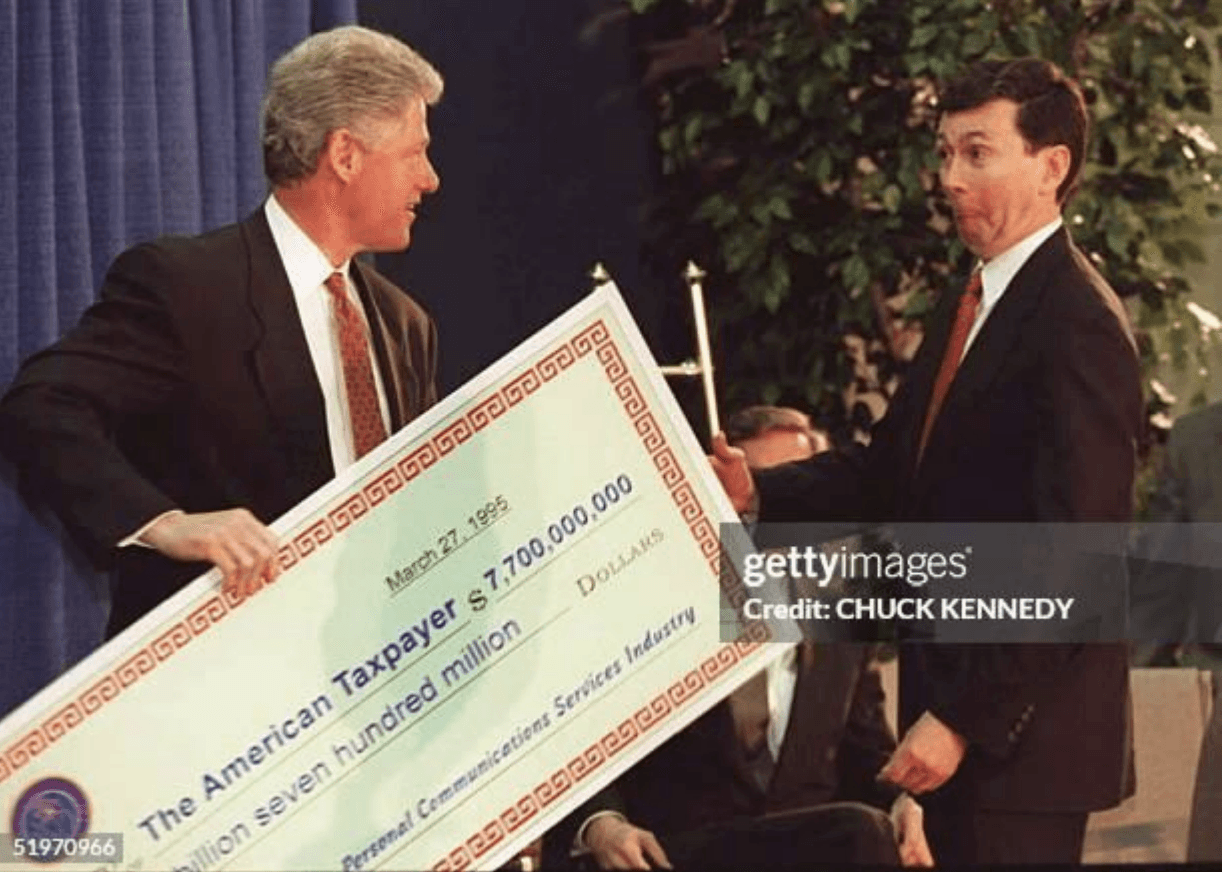
[Clinton, left; FCC chair Hundt, right]
The Bell companies had been given analog licenses for free more than a decade earlier. They had about sixty percent of analog wireless customers, and because of the high cost of these devices these customers were likely to be wealthy enough to be the first buyers of digital phones. They also had nearly 100% ownership of landline phones. They had ample capital. They were sure to win spectrum in the auction, and of course they did. However, If they could buy most of the spectrum sold in auction, then with these other advantages they could dominate digital cellular. It would never be a competitive market.
Designing the auctions and the industry rules to overcome these advantages was our task. With Greg Rosston, our deputy chief economist, leading the thinking, we brought in game theorists like Paul Milgrom, future Nobel Prize winner, many other experts. Our goal was to make sure that the rules in the industry gave new entrants a fair chance to succeed. In particular, it was critical that the Bells would not have the opportunity to buy a monopoly or oligopoly position by throwing money at the opportunity. On the other hand. The auction was supposed to raise more money. And eventually young talent like John Levin, future president of stanford, and our extraordinarily able staff. The plan we put in place had five major features:
We would sell adequate but limited amounts of spectrum in every market so that there would be at least five and up to seven winners. The amount of money one firm could buy in any market was capped. Firms bought the ticket to compete - the spectrum - in the geographic markets they chose. No one could or did buy a monopoly. In every geographic market the structure was competitive. Later, we allowed mergers to create regional or national firms, but we maintained caps on spectrum ownership to assure competition.
All the new digital cellular companies would get plenty of phone numbers. The Bell hold on numbers would be broken.
The auction methodology (simultaneous multi-round multi-day rounds) raised the smallest total amount of money to obtain an efficient outcome. The SMRA method became adopted globally and facilitated efficient competition in many other markets.
We reserved some spectrum for unlicensed use. This ran counter to the goal of the empowering statute, which was to raise revenue. But we felt that new firms with new technologies would take advantage of free spectrum that they would not be able to use exclusively but instead would have to share. This proved to be the genesis of wi-fi networks, and these networks, as everyone in the United States experiences routinely, enabled the computer and then the smartphone to be disconnected from a wire yet still remain connected to the internet.
Later, we had to decide the price a wireless company would pay a landline company to place a call to any landline customer. When hardly anyone had a digital phone and almost everyone had a landline phone, this was a critical issue. Not before the first auction, but later in time we set the price very low, approximately one tenth of a penny a minute. The huge network effect of owning all the homes and businesses that might be called before digital cellular had won its own market share was transferred at almost no cost to all the new digital cellular firms. (To protect state-owned landline telephone companies European nations did not adopt this principle. As a result, their wireless deployment tended to be dominated by the old landline companies, went slower, and they lost the opportunity for leadership seized mostly by American firms using the new wireless platform for many creative new purposes.)
The goal was to have all the firms launch their businesses at about the same time and then race to build network and acquire customers. It was the Oklahoma Land Rush, the race to build the transcontinental railroads, the pell-mell contest of enthusiastic entrepreneurs. That is pretty much what happened. Money poured into this activity from around the world. One new firm, now called T-Mobile, eventually proved to perform the best of all the new digital companies.
The FCC's authority to regulate wireless was vast, virtually unbounded. We could have set the retail prices for the service. We chose not to do that. Analog cellular had been provided by two firms in every geographic market and they had kept prices high and roughly the same, choosing in addition to mulct customers for extra revenue if they roamed outside their territory. The fundamental advantage of wireless was travel: you could take your phone with you. Yet that market structure penalized customers for travelling away from their home city.
Our view was that five firms competing would not be able to agree on price. They could not organize a retail price fixing conspiracy even if any had been so inclined. If they were racing to win customers and use the revenue to support debt that built more networks serving more customers, then the famous invisible hand of the market would set the price. Indeed, it would probably be lower than any regulator would have the acumen or courage to dictate. Our prediction proved valid. Even better, fairly soon the larger firms offered bundles of minutes - the customer could use the minutes to call anywhere and from anywhere. That was the end for long distance as a service. It also caused still more incentive to build networks out quickly. The more places a customer could call, the more value the customer would find in subscribing to wireless.
California decided to require cellular license holders to sell service to intermediary firms. We preempted California. If intermediaries proved useful for license holders or customers, we bet that the market would support them. Government did not need to require that they be supported and determining the price to sell service to them would be a backdoor way of price regulating the industry. We did not want to do that.
The FCC had the authority to dictate the software that would be used for wireless. Europeans and others argued that the standard popularized in Europe, GSM for global system for mobile communications, should be mandated for all countries. This would provide scale for device
manufacturers and lower costs per cellphones. The Europeans were right on that point, in theory, and practice they claimed it was only a coincidence that the European device maker, Nokia, would become a huge global success if its software standard were mandated everywhere, but especially in the United States. A rumpled professor from San Diego named Irwin Jacobs shuffled into the office of the FCC chair and argued that his standard, CDMA for code division multiple access, could carry more information per wavelength than GSM. It would cause more services to be delivered wirelessly at a lower price per bit. The FCC decided that standards companies should compete in the market and not at the FCC to see who won.
CDMA, housed at the San Diego firm called Qualcomm, won some adherents in the United States. They had more than one potential buyer because of our competitive model. Ultimately the Clinton Trade Ambassador won them access to the Chinese market, realizing that part of the grand government strategy. Although the standards competition did raise numerous technical issues, they were solved in the market and in research labs. The government did not have to pick a winning software standard or a winning firm to jumpstart the wireless market. Ultimately, through generation after generation of wireless standards, the capability to send information improved steadily and the value of a wireless service rose, benefiting firms and customers.
Meanwhile, in 1994 the FCC also rewrote its cable regulations to fulfill the twin purpose of the Cable Act: lower prices and provide competition to cable for the first time. Basic service prices went down everywhere. The cable companies had to invest in new capacity to add channels. That investment ultimately enabled them to be broadband providers as they repurposed their coaxial cable capacity to carry Internet traffic. They were not grateful for the stimulus and began lobbying for repeal of the Act.
Implementing the Cable Act, we also told the cable firms they had to share the cable channels that they owned (some were vertically integrated) with satellite firms. This created competition for cable from satellite firms. Dishes on roofs offered at least some choice for consumers.
It was a hard and ultimately good year for the FCC and for the Gore agenda. But politically the year ended in calamity for the Democrats. The Republicans took control of the House and the Senate. The Democrats had held the House continuously since 1954, two generations, 20 Congressional elections.
One casualty was the 1994 Telecommunications Law. The new speaker of the House Newt
Gingrich and the new senate leader Bob Dole wanted to do that bill over. They would favor
their favored industries and firms more and fill the coffers of their campaign committees with contributions from these lucrative supplicants.
1995: Rewriting the Telecommunications Act, Saving the FCC, and Battling for the E Rate
The new Congress immediately began rewriting the 1994 version of the Telecommunications Act. Speaker Gingrich proposed to eliminate the FCC and replace it with a small executive office reporting to the president (similar to what the current president has done). Gingrich met with the industries and asked them what they wanted in the new law. Then one of his allies held a meeting asking them all to contribute to the party's campaign funds.
At the FCC, we did not relish the prospect of being closed down. We also feared the new law would represent a compact between monopolies and the political party now controlling Congress. That law too would not include the E Rate.
Our spectrum auctions, however, were a huge success. The idea of selling public property for cash appealed to conservatives and neo-liberals alike. Our pro-competition rules for the new digital cellular industry were hardly libertarian but the new firms competing in the auction liked them and the Bells did not want to jeopardize the passage of the new bill by opposing the way we were designing the wireless industry.
Then as the long distance and local phone company lobbyists battled from office to office on the Hill it also became clear that any new telecom law would be a compromise. Moreover, the President had the veto threat to use if the bill was not at least roughly consistent with the Clinton-Gore agenda. In addition, the bill required an immense amount of detail to put into effect the new paradigm. No small office at the White House could have handled it. Our FCC could do it, and increasingly we had the trust of both parties.
Meanwhile, Republican Congressman Jack Fields rewrote the bill that would become the 1996 Act. He was no fan of the E Rate. It seemed like another big government handout. That was not completely incorrect, although we never talked about its size. Vice President Gore and Congressman Markey (who came into Congress together in the 1970s) persisted in arguing to include it in the bill. At the agency, with Karen Kornbluh joining us from Senator John Kerry's office taking a leading role, we met with numerous members of the House and Senate, on both sides of the aisle. We talked about the E Rate all over the country. Education groups came together to argue for it on the Hill. Thanks to Congressman Markey's smart move, the program did not need an appropriation. The language only needed to let the FCC put a charge on the phone bill.
Late in 1995 the issue of staying in or being kicked out of the Act came down to a key vote in a Senate-House committee. Republican Senator Olympia Snowe cast the winning vote for the E Rate, joining Democratic Senator Jay Rockefeller to put the Senate in favor of the program. On the House side Democrat Ed Markey persuaded Republic Tom Bliley to support it. Senator Snowe extracted a promise from Chairman Hundt to explain the E Rate to a high school in Bangor. That was easily given. Tom Bliley's district included a large AT&T office, and he wanted that firm treated fairly. We did that too. The E Rate stayed in the law. And FCC chair Hundt has a photo of himself with Newt Gingrich wiring a classroom in D.C.
1996: Implementing the Telecommunications Act
Even though 1996 was a presidential election year, the Telcom Act was enacted in January. As a compromise between Bells and long distance and between Republicans and Democrats it won 91 votes in the Senate and 414 in the House. The drivers, Congressmen Jack Fields, Ed Markey, Newt Gingrich and Tom Bliley of Richmond; Senators Larry Pressler, Fritz Hollings, Jay Rockefeller and Bob Dole knew the law was important but for many members the issues seemed technical. The general deregulatory label meant the Republicans and neoliberal Democrats could agree.
The President signed the bill not only digitally but also with ink pens, using one pen for each part of his signature, thus creating a dozen such pens. Ron Brown, Commerce Secretary, grabbed one for FCC Chair Hundt, who has it framed on his wall, in memory of the FCC staff's work and also in honor to Ron, who died in a plane crash over Dubrovnik, Croatia, less than two months later, April 3, 1996.
Speed again was our mantra: speed, transparency, and clarity of decision making. The new law, described by a bipartisan chorus as deregulatory, required the FCC to do more than 100 rulemakings and other agency actions, all pursuant to the Administrative Procedure Act's time- consuming procedures. Editing the rule of law to stimulate competition (open closed markets, create new markets) instead of regulating monopolies was like turning Anna Karenina into a romantic comedy, said one of the literary savants on the FCC team. You had to change the characters, plot, style, and denouement.
The natural effect of lobbying a multi-member commission is to drag things out. Therefore, we asked Congress to insert due dates for rulemaking in the legislation itself. This enabled the chair's office to insist that the other commissioners make decisions, not drag their feet. Then
we had to announce and commit ourselves irrevocably to a series of actions reflecting the detailed notice and comment procedures of the Administrative Procedure Act of 1946. With the current Supreme Court apparently contemptuous of the efficacy and utility of agencies, perhaps it is pointless to point out that we were completely successful in adhering to the Act and ultimately were vindicated by the Court in AT&T v Iowa Utility Board, U.S. (1998) (J. Scalia writing in a 5 to 3 decision).
In February, FCC senior adviser Ruth Milkman shocked the Washington lobbyist and communications lawyer (and businessperson) audience when she audaciously described the FCC roadmap. We would decide all four dozen rulemakings within 18 months in a set order. At the end would come the decision on whether to let the Bells into long distance. The opportunity for the long-distance firms to enter local service markets would come earlier.
The essence of the new regulation was that the long-distance companies would be able to buy use of the Bell landline monopoly networks. Defining and pricing that access was the FCC's job. It was immensely complicated, battled over vigorously by powerful lobbyists, and of course all our rules where challenged in the Supreme Court, where the FCC won. Our central idea was to give the long-distance firms time to attack this market while the Bells would have to wait, and comply, in order to get entry into long distance.
In many additional clauses of the bill, the rate regulation portions of the Cable Act of 1992 were repealed, but the more important program access rules that enable satellite competition survived. Radio was allowed to consolidate. Of vital importance to the Vice President, Congressman Markey, the FCC, and the schools and libraries of the country, our E Rate was authorized.
It took another year after the Act to get the classroom and library funding rule in place. For the last three decades about $200 billion has been spent on this public purpose. There has never been a Congressional appropriation to this end. The FCC raised the money. [13] To administer the funds, we created a nonprofit with the anodyne name United States Administrative Corporation. This reflected the advice from Education Secretary Richard Riley - do not leave the program at the FCC or put it at the Education Department because if you do some Congress sometime will kill it. That technique was also challenged but the FCC prevailed. [14]
To implement the whole act, the midnight oil was burned; the FCC ran up huge electricity bills; people worked until they dropped. But the industry got the clarity it needed, save for the inevitable interference by the judiciary. And as a result, investment took off.
1997: International Success, Completion of the Act's Mandates, and the Triumph of the E Rate
In 1997 the Trade Office and the FCC completed an agreement among 69 countries as part of the World Trade Organization rule of law that fulfilled most of Peter Cowhey's goals. At about the same time Trade Ambassador Barshefsky concluded her goods and services agreement for information technology. The WTO agreement for which the FCC was principally responsible included an agreement on regulatory principles for the signing countries. This sort of reconciliation of ideas - adoption of a common strategy - would be ideal for AI deployment on a global level. In our case three decades ago we agreed to open our markets reciprocally with the market opening moves of other countries. This could be labelled free trade, but it was not so much the absence of tariffs as the agreement to think alike in terms of governance and regulation that expedited the spread of the Internet and digital cellular, as well as all the follow- on businesses, like the I Phone, everywhere in the world.
We completed everything the Act mandated by May 1997. This was probably about two or three years earlier than the industry had expected. As a result, the affected firms made their business decisions more rapidly than they expected.
An especially gratifying success was the rulemaking and other actions that transmuted the E Rate from legislative authority to an operating system. Because we had made it a priority, the telephone industry chose not to oppose it. They had bigger fish to fry. As a result, we succeeded in raising the E Rate money by imposing a charge on telephone bills. It was progressive, roughly; the more someone spent on calls, the larger the charge imposed on them. The Congressional sponsors stayed involved in the process, especially Senator Rockefeller. The education and library communities argued forcefully for adequate funding. McKinsey wrote a helpful report. President Clinton supported the program of connecting every classroom to the Internet in a commencement address. We rejected pressure to pay 100% of Internet access cost and obliged schools and libraries to put some of their own funds (skin in the game) at stake in the contracts they wrote with providers. A joint board of state and federal officers were involved in the decision (the federal government always does well to include states in major programs); the supportive state vote immediately followed President Clinton's reelection, which was no coincidence. The final rule was completed early in 1997.
Ira Fishman led a terrific FCC team through this more than one year effort to enact the rule. He then set up the nonprofit we used to administer the program. Years later Chairman Tom Wheeler expanded and improved on the program. Within a few years after the program was started more than 90 percent of all classrooms had internet access. In total, from state and federal sources, about $200 billion has been spent to make sure that no teacher, no student, no librarian or library user, would lack Internet access. This is the greatest single spending by a federal program in education other than the program to provide hot lunches in schools for low income students.
In the summer of 1997 AT&T's decision was to give up. It proposed merging with Southwestern Bell. Noting that AT&T had promised for all the previous years of the decade to compete with the Bells, I as the FCC chair called the merger "unthinkable." It was called off. AT&T got a new CEO, Mike Armstrong. He bought most of the cable firms in the United States but unfortunately decided to use them to provide voice service. The right answer was the one that had also escaped John Malone: use them to provide the Internet. Armstrong bought cable at a high price with borrowed money, suffered a drop in stock price along with the 2000-1 downturn, sold cable firms mostly to Comcast, and ultimately in the Bush Administration Southwestern Bell bought the residue of T for a tenth of the price of the original merger.
AT&T also made the mistake of spinning off its wireless business. The Bells meanwhile rapidly consolidated, ultimately producing the huge firms of Verizon, originally New York Tel, and AT&T, born as Southwestern Bell. [15] We at the FCC urged the Department of Justice to limit the consolidation of the Bells, but they were focused on suing Microsoft, and they could not see why merging geographic monopolies into larger geographic monopolies posed a risk to competition. We argued that the resulting firms would have huge competitive advantages in acquiring products and in marketing. We could not persuade the antitrust division.
Meanwhile, the leaders of the consolidated Bell system knew the future was wireless. Their reinvention of their firms as national wireless carriers instead of local landline voice firms stands as the largest and most successful change in business purpose and function in American business history, or perhaps global business history.
This was very much part of our plan. We wanted big winners. We did not want to pick them. In other words, we purposefully picked winning industries but not winning firms in industries.
Looking back, anyone has to agree that one specific purpose of the statute - to let two separate industries take some of each other's share - did not happen. But the FCC did not hold up the vertical integration of local Bells with long distance until AT&T could win a third or half or some other arbitrary amount of local customers. That would have been too much stage management of the actors by the producer of the show. The other specific purpose - to let the telephone companies into the cable market and vice-versa - was achieved. As an example, many households now can choose between Verizon Fiber and Comcast Cable for broadband.
Instead, we implemented the spirit of the Act: let competition produce winners and they were the winners. The long-distance firms did not succeed in this effort. Really only AT&T even tried, and if they had bought cable in 1994 after rate regulation had temporarily depressed stock prices they might have succeeded. But time and change did not favor AT&T.
Summing Up Part One: Fantastic Outputs
The single most important aspect of the 1996 Act was that it substituted, for the most part, market forces for a regime of judicial and agency regulation governing communications technology. The computer industry, including both hardware and software, had long before benefitted from the lack of regulation. Communications, however, had been intensely regulated at the state and federal levels since the 1913 Kingsbury Commitment. As the national monopolist for both local and long-distance telephony AT&T could not go out of business. More importantly, it did not need to innovate, create new lines of business, or be increasingly efficient in order to reward its shareholders and comply with government regulation. The 1996 Act ended this government-encouraged complacency forever.
The FCC had a great deal of political support from entrepreneurs and technology firms. This was long before the broligarchie came into being. Backed by venture money and then large Wall Street firms, firms seemingly all from Silicon Valley created competition and Schumpeterian creative destruction in many markets. The Act's general deregulatory spirit coupled with the FCC's specific market creating actions produced huge investment, innovation, and animal spirits in the stock market too of course. The government strategy did require making big bets, and we placed them on the computer networking we call the Internet, or the Web, coupled soon
enough with digital cellular. If the bet were wrong, business failures in market would show that. If right, business successes would accrue to the general benefit of the national and global economy.
Core to this approach was the strong belief that markets can better drive productive change than micro-regulation. But we also thought regulatory intervention grounded in a larger strategic vision can help structure markets correctly. That intervention is critical to maintaining competition as increasing returns to scale in technology could tend to create dominant winners then able to slow or eliminate new competitive threats from new forms of innovation.
We also believed that markets alone do not deliver all the public benefits that a technological revolution can enable. To this end we battled for and succeeded in executing on our E Rate program. Thanks to the FCC and a legion of supporters in education, libraries and the private sector we were all able to get the internet into nearly every classroom and library in the country. As a result, the internet from its earliest commercial days was available to rich and poor alike at about the same time. That had not happened in education since the introduction of chalk.
The measurement of success for us in the 90s was output and consumer impact. We wanted more production and more sales of many things: personal computers, digital cell phones, fiber optic cable, software, content (including news and entertainment) and content from many sources (not just network television or local newspaper monopolies). And we wanted consumers - real people, working people, voters - to pay less for more. To pay less in terms of getting more value per dollar when buying a personal computer. To pay less per channel in the cable bundle of channels. To feel that the world was their oyster and things were getting better every day.
This chart shows the cost reduction in televisions and cellular service that occurred.
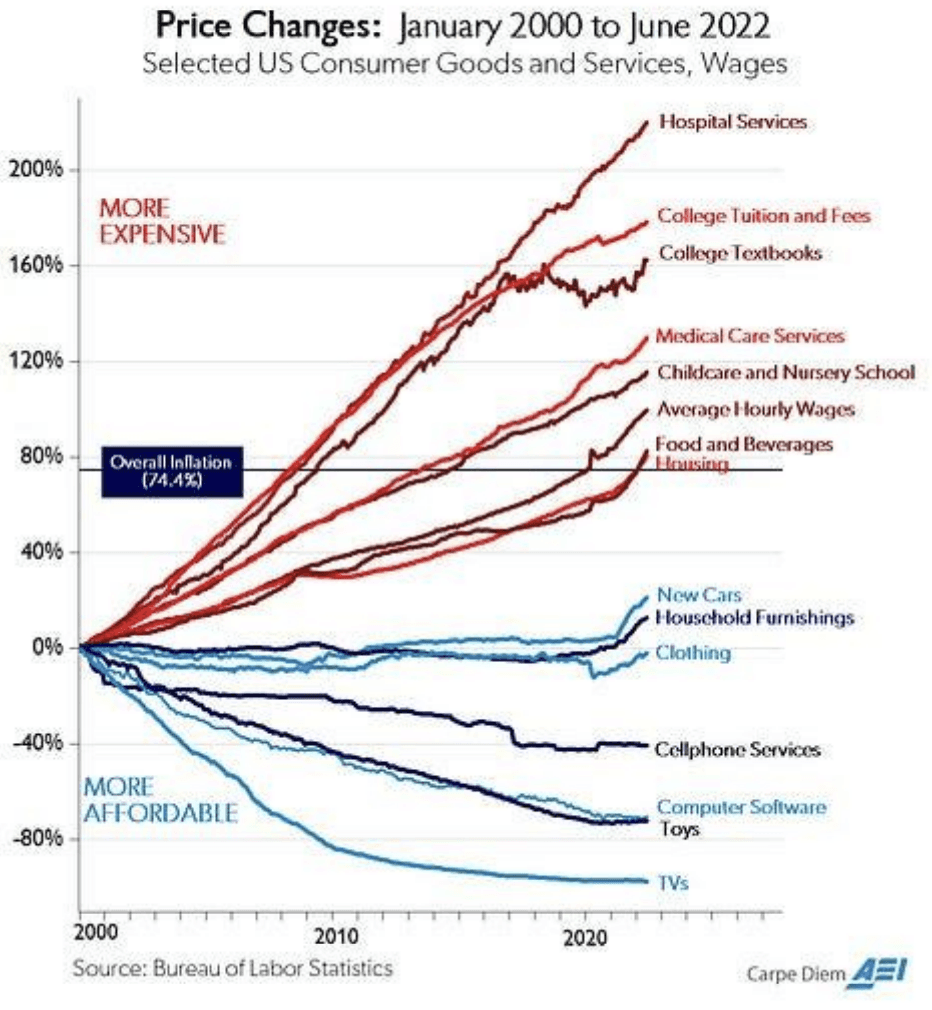
The technology boom in the United States caused real income to go up for every income quintile. That had not happened for the previous three decades. Burgeoning revenue led to a balanced federal budget in the last two years of Clinton's term. Comparing gross domestic product in 1997 to 1999, the United States growth accounted for 91% of total global economic growth. [16] The economy grew continuously from 1991 to 1999, the longest such growth in American history at that time.
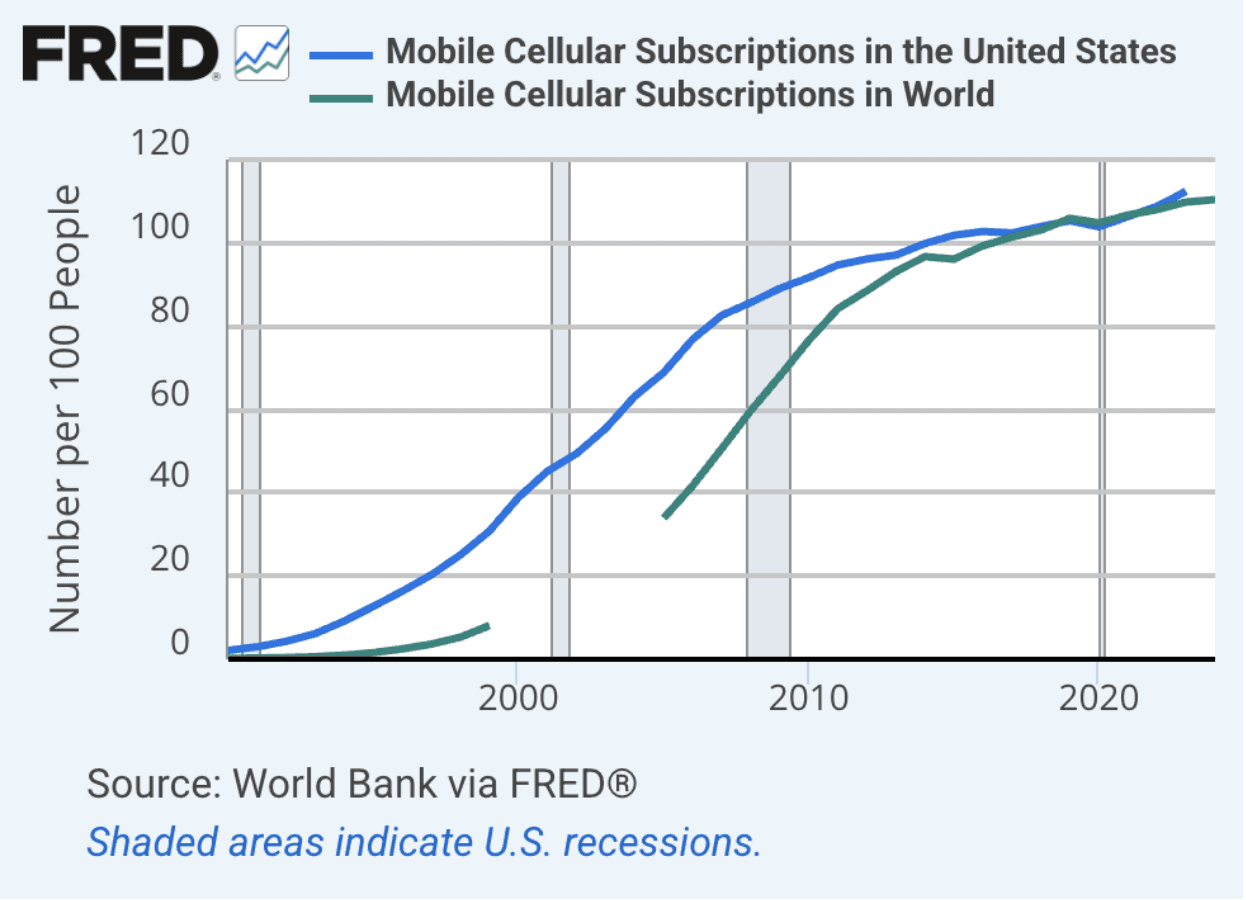
Not only did America lead in wealth creation but also it inspired ideological imitation. Capitalist democracy strode the planet. By 2000 the majority of the world's population lived in democracies, for the first time in history. The cellphone and Internet networks wrapped the world. Now six billion people have mobile devices and Internet access. The global digital medium is by no mean everywhere safe or grounded in reality. But it did enable the development of life-saving vaccines to reduce drastically the death toll from Covid. It is still the way all the people of the world can together address global problems.
During the Clinton-Gore Administration, as Gore used to say, "everything that is supposed to go up, is going up and everything that is supposed to go down is doing down."
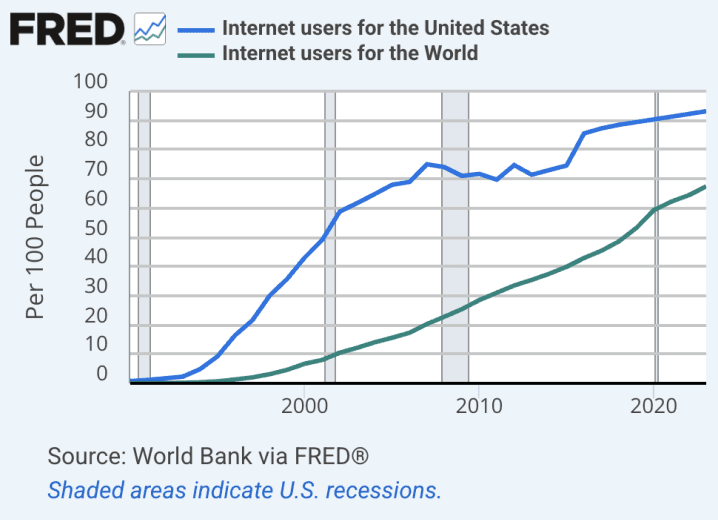
As we hoped, the United States led the world in change. Most saliently, the United States was the early adopter on the planet of the Internet.
Summing Up Part Two: It was the team
A major part of our success was operational. At the FCC, a bipartisan agency, nearly every vote on every issue for four years was unanimous. The Clinton Administration appointed only two of the five commissioners from the ranks of supporters, Reed Hundt and Susan Ness. To get a majority of five commissioners, we had to be bipartisan. It was also important to be bipartisan to defend against judicial review, which often used conflict between commissioners in writing to overturn agency decisions. None of us wanted our work cancelled by judges with strong predilections (and smart, but small and nontechnical staff) who thought they could read the statute and do our rulemaking better than we could. [17] Critical to bipartisanship, from the perspective of the chairman's office, was the reliance on expert staff to formulate and present rulemakings to all the commissioners in a steady, deliberate manner. The commissioners might have been willing to disagree with the chair for political reasons. They were less willing to differ with the agency staff.
The staff of the FCC was perhaps the finest or one of the finest collections of talent any agency ever assembled. The President of Yale, many business executives, numerous academics, and many Senators acknowledged the fact that the FCC staff was brilliant and, more importantly, extremely hard working and fair minded. with no disrespect to the chair or any commissioners, the "staff" means all temporary and permanent hires, whether holding civil service grades or temporary appointments, but does not include the Senate confirmed positions. It's important to call out careerists that the Clinton-Gore team met at the FCC and who became leaders of every initiative from 1993 to 1997. These included Robert Pepper, Evan Kwerel, Mary Beth Richards, Gerry Vaughn, Ruth Milkman, Jay Atkinson, Jackie Chorney, Tom Power, Elliot Maxwell, and many others. They were joined by many who learned from and with them.
Among these were Don Gips, Tom Boasberg, Kevin Werbach, Gretchen Rubin, Bill Kennard, Julius Genachowski, Chris Wright, Ruth Dancey, John Nakahata, Kathy Wallman, John Logan, Judy Harris, Susan Sallet, Larry Atlas, Gina Keeney, Richard Metzger, Michael Buas, Karen Watson, Jamie Rubin, Ira Fishman, Karen Kornbluh, Meredith Jones, Karen Brinkmann, Jon Neuchterlein, Andrew Sinwell, Jay Markley, Kim Malone, and of course the ringleader Blair Levin. On the Hill, leaders included Gerry Waldron, Colin Crowell, and many others. [18]
Two of this group became FCC chairs. Two became ambassadors. [19] Many gained prominence in government, academe and business activities in the decades that followed our time. Two even made the bestseller lists and sold millions of books. (The chair and chief of staff separately and together wrote books that in the aggregate might have sold a couple of thousand copies.)
Another key to operational success was that we kept everyone busy - those in Congress with jurisdiction over the agency, the watching public, the lobbyists, the commissioners, the news reporters, everyone. To that end, in addition to the grand strategy, we had other successes: children's television, coordination of hearing aids with cell phones so the hard of hearing and deaf could make cell calls, many other things. We thought these moves were all in the public interest (always being aware that the public interest has little effect without private investment driving the ultimate outcome), but by expanding our range we enlarged our reputation for getting things done and we kept the pressure on the other commissioners to make decisions. Particularly in bipartisan bodies, idle hands are the devil's opportunity - where the devil comes in the shape of industry lobbyists. [20] Our plans also included the purposeful creation of new services for groups of users that lacked the ability to pay what businesses and most consumers would pay. These included low-income households, libraries, public and private schools, people hard of hearing or deaf, native Americans, and others. The pressure of all these initiatives helped hold us together as a team.
By taking on many issues, we developed many constituencies. Listening and responding to them became a core operational principle for us. In doing so, we demonstrated to the American people that they could trust an institution to serve the public interest.
Summing Up Part Three: Unhappy Suprises
A big unanticipated outcome of the widespread deployment of the Internet was that the social media dominated the platform. These firms should have been subjected to a national regulatory regime. Instead, their negative effects have gone unaddressed.
The problem was Section 230 of the Communications Decency Act, incorporated within the 1996 Telecommunications Act. It immunized social media from litigation (to make a complicated story brief). Its purpose was to encourage participation by anyone and everyone in the emerging virtual world of the internet. The road to legislative hell is often paved with new invention.
The business model and algorithms of Facebook and Google aggregated the commentary that section 230 imagined individuals would post on the virtual walls of the Internet. It came to pass that opinions, facts, cons, scams, and cruelty composed the content of the Internet. Our favored technologies had neither improved nor worsened human character. They had made it more manifest, and at scale.
The companies themselves, however, had escaped responsibility for how their sites were used. They should have had the mediating role played back in the day by newspaper editors or broadcast television executives. That role might have been imposed on them by litigious victims or social pressure.
Section 230, instead, gave these firms permission to run rampant through the consciousness of everyone in the country, including children. It should have been repealed. Even better, it should have included the grant of regulatory power to the FCC for constraining the use of algorithms. At the least, social media firms should be required to protect children. Arguably, the FCC could have invoked Title 2 of its regulatory authority to impose safeguards on the way social media enables content to affect children. This issue is not going to disappear, and it is regrettable that our strategy did not foresee, or include the ability to adapt to, the negative effects of social media. [21]
A second unanticipated result was consolidation of markets, or the failure of consolidation to dissipate in the wake of near universal action. Three decades into the communications technology revolution, as Ted Gioia has explained in his newsletter, January 11, 2026:
--four movie studios control Hollywood
--four subscription platforms attract two-thirds of home movie streaming
--three record labels own most popular songs
--one firm controls more than 60% of the American audiobook market.
According to Pew Research, 84% of adult Americans use Google's YouTube, and Meta attracts 71% to its Facebook, and 50$ to its Instagram. No other platform attracts as much as 40% as users. [22]
We expected that the very low cost of creating content and transmitting it online would inevitably lead to self-perpetuating competition and preclude monopoly shares from being created in any markets, including the market for attention. We did not anticipate the effects of Metcalfe's Law: value equals the square of the number of users. In other words, the larger the number of users of one side of a two-sided platform, the greater the value of the platform to its owners and especially to the other side. Similarly, when many people carry a Visa credit card, then stores will pay fees to Visa for participating in its payment process. When many people watch YouTube or take a look at Facebook or Instagram, then advertisers pay a lot to Google and Meta for the right to put their ads in front of people. These two-sided platforms, giving access for free to users and charging advertisers for access, showed Metcalfe's Law in practice and became hugely valuable but also dangerously powerful. Antitrust, to this date, has not developed the theories or shown enough rigorous application of theory to the problems of consolidation in the digital age.
The problems of section 230 and consolidation could repeat themselves in the AI world to come. When AI agents create postings on websites, will their creators invoke section 230 immunity? If AI leads to consolidation in the attention market or in the sale of AI services, will antitrust law be sufficiently powerful to defeat claims that one or two AI firms suffice to serve us all, even if they extinguish rivals and dominate our consciousness?
A third surprise for us was the magnitude of the stock market boom of the 1990s. It is one thing to trust the market. It is something else to be indifferent to its irrational and inevitable impulse to over-invest, over-sell, and over-do every new thing. The boom of the 90s comprised over-investment in computers, software, fiber optic cables, telecommunications infrastructure, and the stocks of companies involved in these activities. In the aggregate the investment was a smaller fraction of the American gross domestic product than railroad investment, and about the same as artificial intelligence, which is well on the way to setting a record that far surpasses the communications technology boom. For the stock market, the peak was in March 2000. If it had been reached in December 2000 or later Al Gore would have been the President in 2001.
The FCC's creation of new markets and opening of closed markets contributed to the boom. The Internet, wireless, PC, digitization, fiber, and microprocessor innovations all collectively called for huge increases in capital investment, dramatic changes in business plans, world- changing venture capital investments, millions of new businesses (literally), enormous changes in workforce composition (think of coding alone for example) and training. The vision was shared by hundreds of thousands of entrepreneurs, seasoned executives, sophisticated investors, and the FCC. The money came pouring in.
However, the stock market suffered, as Alan Greenspan put it, from "irrational exuberance." That was manifested most dramatically in a widespread belief by the late 1990s that the volume of Internet traffic was doubling every three to six months. This proved wrong; more like 12 months was accurate.
When reality began to intrude on investors' animal spirits, revenue expectations were adjusted. Some businesses could not pay their debts. Others saw their value plummet. Investment then dropped. The downturn happened.
A similar scenario in the housing market occurred during the lax regulatory regime of the Bush Administration, roughly from 2006 to 2008. The calamitous financial crash of September 2008 resulted because of the huge role housing investment plays in the overall economy.
The same scenario - aggressive growth assumptions that prove unreal - may occur for AI companies. No one knows if AI solutions will be adopted with the speed and scale required to reward the massive investment in data centers and software as well as implementation that is the business story of AI. If adoption rates are now being exaggerated, the downturn in market value of the affected firms could be sudden and severe.)
Could the FCC have postponed the peak of the boom or lowered the size of the boom? Certainly not on its own. If it had acted more slowly and discouraged investment the country and the world would not necessarily have been richer or happier. Nevertheless, it would have been better if more people in government had tried to reduce the size of the boom or acted more prudently to mitigate its effects. This lesson applies now to AI. It would be good to have an agency in government focusing on the topic now.
Conclusion: The Past Should Be Prologue
The FCC in the 1990s proved at least to itself that hard working people can do honest, smart work in government with good intentions that are mostly realized. To this end it was critical to have a functioning organization with expertise in economics, technology, law, and business.
That organization needed to be dedicated to the public interest. It also had to be the glue that held together in common purpose all three branches of the unwieldy divided government designed by our serviceable but awkward 18th century Constitution. In short, it was an independent agency.
That organization - the FCC - not only established a rule of law but was governed by one. It could enact rules only by adhering to the Administrative Procedure Act. That dictated a process of proposal, comment, listening, written decision making and judicial review. This was a time- consuming process that required of the agency listening and discussion, as opposed to secret decisions secretly arrived at and peremptorily announced. As opposed, in other words, to executive action. It was a good way to proceed, and although mistakes were still made, they were reduced in number and scope. This process militated against enormous errors.
The process also supported norms. These are the web of expectations, assumptions and behavioral patterns of the past that governed our conduct. We did not feel hampered by the precedent of norms - we felt it helped make all stakeholders understand how to participate in the progress to which we were all committed.
The FCC, and the relevant actors in the legislative and executive branches, as well as the many stakeholders in the private sphere, had to embrace a strategy. For many topics, our agency needed to explain it. Endless explanation is the key to leadership and in speeches, meetings, and innumerable conversations we were always trying to name the goals, describe the complications, and elucidate what we thought were the right resolutions. Again, none of this precluded error but it all helped us do mostly the right thing most of the time with mostly good results.
Outcomes had to be measured and examined constantly with the goal of reconsidering and adjusting the strategy as needed. The quintessential example of this for our story was the National Broadband Plan that Blair Levin created for the FCC in 2009-10. That was a review of what the 90s strategy had intended, identified failures, and defined a new strategy that learned from experience and took into account significant changes in technology and society in the intervening years.
Currently, there does not appear to be any government organization comprehensively addressing this obviously enormous technological innovation. Missing from the picture today is a group of talented people conducting a transparent process to define the public interest. No such group has the authority to write regulations. The norms are ambiguous or lacking; mostly, the smartest people in the world appear to be committed almost entirely to becoming hugely rich with the consequences of their wealth accretion ignored by them and everyone else in government.
Why should there not be an Artificial intelligence Commission with a bipartisan composition and a statutory remit? Some, maybe many, in this time of loathing from the left and right at defenseless government may react violently even from the mention of such an institution. A big problem is the dramatically different culture of the technology sector compared to three decades ago. To quote Josh Marshall from Talking Points Memorandum: "We start with the fact that the Silicon Valley of 2024 (set aside what happened last year) is vastly different from that of 2004. Wealth and power are both highly concentrated and platform monopoly is the
dominant business model. From 2023 to 2025 you had big parts of Silicon Valley move decisively into the camp of the global authoritarian movement." [23]
Nevertheless, the case for an AIC is not weak. [24] Here are nine reasons for creating such an agency.
First, AI might manipulate minds (so that we could not know what is real and what is not), increase the dangers of social media addiction tenfold, build viruses that make past pandemics look like the common cold, and escape all human agency. The final sequel to the Terminator franchise, warn, Yudkowsky and Soares, is the title of their book:

Given this worry list, the right move is to organize expertise in a government agency charged with defining and assuring that the public interest is advanced by AI. That agency should work with both the legislature and the executive branch as well as with state government, the private sphere, the academy, nonprofits, and the public at large. It is particularly important to recognize that in the American system, at least as it was constructed three decades ago, the stewards of the public interest must recognize that the power of private capital is vastly greater than the effect of government regulation. We should not assume AI will have bad effects, but we should have an agency thinking about the issues.
Second, the reaction to the end of the communications technology boom in 2000 was for government to make two blunders in a row. First, the Clinton Administration should have distributed the budget surplus early in 2000 by sending checks to every household and funding childcare through tax credits. This would have elected Gore but if that seems to political, it simply would have mitigated the downturn. Second, the Bush tax cuts of 2001 and 2002 contributed to the rising deficit even now burdening the American economy.
We ought to be able to learn from that experience. Again, we have a boom. This is obvious. According to Jason Furman of Harvard, investment in information processing equipment & software is 4% of GDP but accounted for 92% of GDP growth in the first half of 2025. GDP excluding these categories grew at a 0.1% annual rate in H1. What cannot continue forever, eventually stops. Best guess is that 2026 will be another AI driven growth year. But when it all does slow down, then what? Let us have some people thinking about the response in advance.
Third, technological revolutions always have major impact on employment. The communications technologies eliminated many jobs in many fields. While employment in software publishing, data processing, and internet publishing grew, newspapers, broadcast television, landline telephone network maintenance (the Communications Workers of America did not enjoy the boom), and many others declined. Similarly, there is a possibility that AI will lead to reductions in the number of people employed in various important job classifications. Guesses vary dramatically but the threatened sectors include data entry, processing, manufacturing, assembly lines, customer support, coding, and many others where repeated motion and limited information exchange make artificial intelligence a plausible substitute for people.
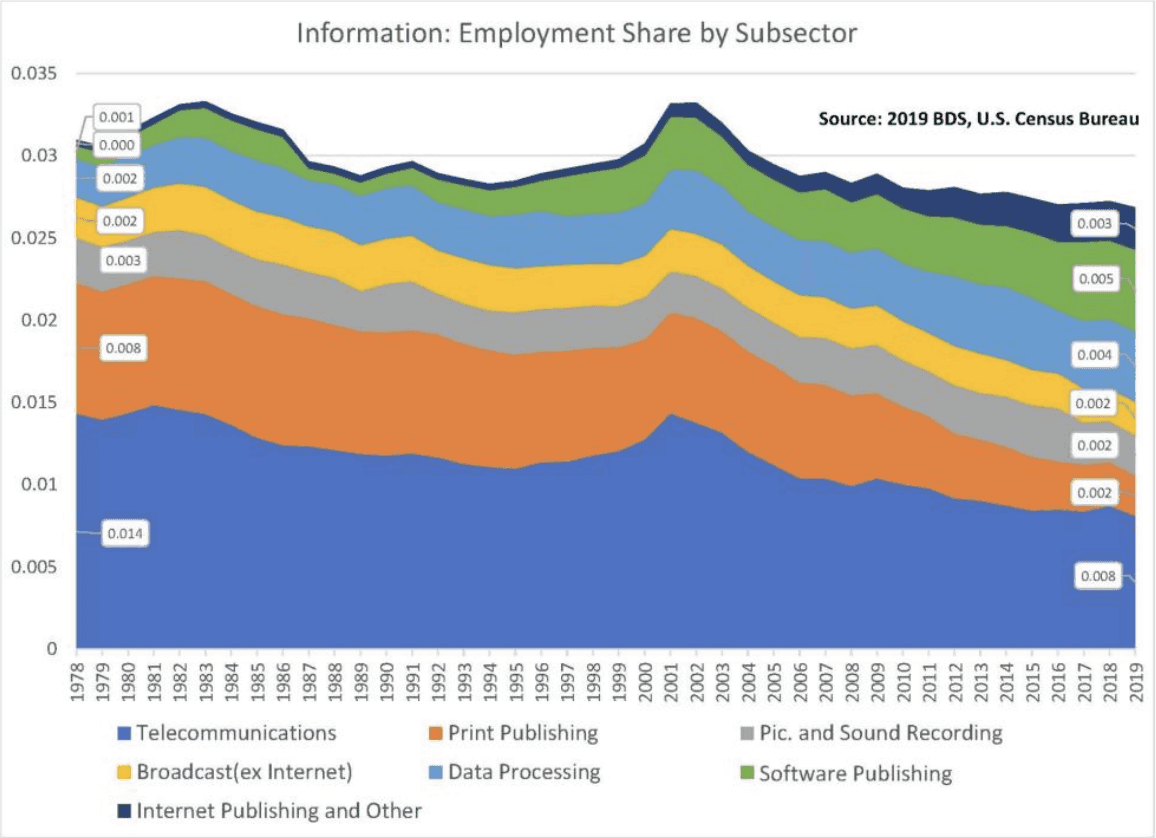
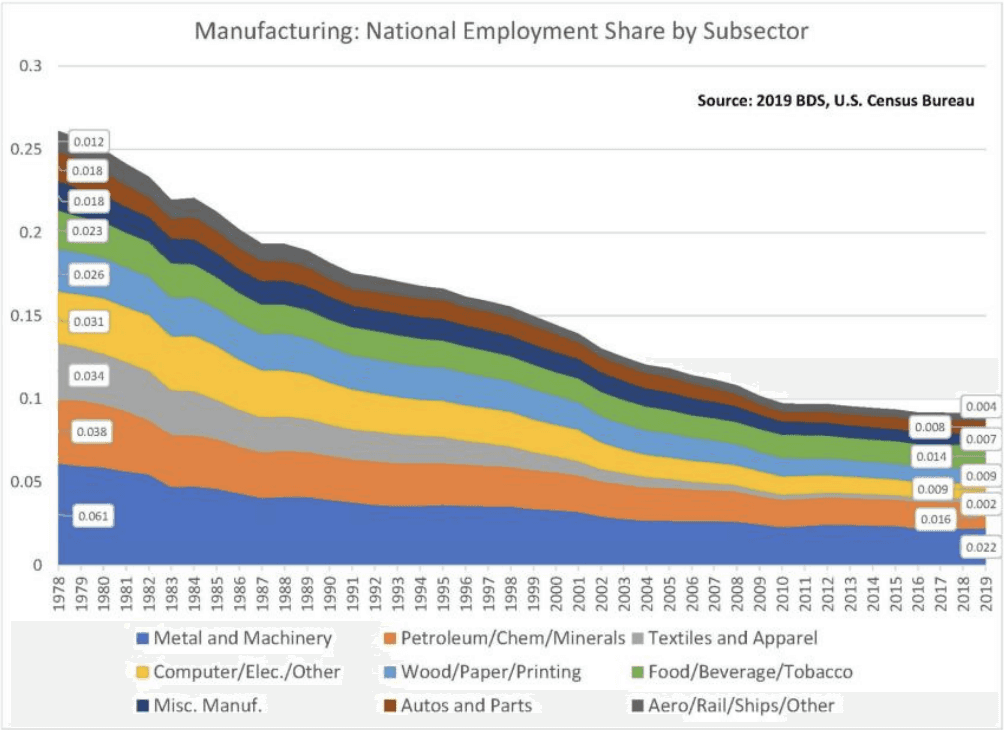
Current estimates on the impact of AI on job displacement or automation range from the troubling -Forrester predicts that 3.4% of U.S. jobs will be lost to automation by 2030- to the catastrophic -McKinsey estimates that up to 30% of hours worked across the U.S. could be automated by 2030. Roman Yampolskiy, University of Louisville computer science professor, suggests that "In five years, we're looking at levels of unemployment we've never seen before... Not talking about 10%, which is scary, but 99%."
Regardless of the unemployment outcome, AI promises to have a large impact on the nature of all employment. Right now, a department or agency of the national government should be planning the re-training necessary for those who might be thrown out of work. Colleges and universities should be examining their courses and investing in faculty to teach what will be useful for work that AI will need humans to do.
Fourth, the FCC was the first government agency to have a website. Quickly all governments went online. Over time, many government functions became much easier for people to use because they took advantage of the Internet.
AI surely will have similar impact on government functions. Perhaps total government employment can be reduced. But many issues other than the size of government must be thought through. Here are three:
All government can be thought of as the creation and management of structured databases. Should this data - who votes, who pays taxes, where do people live, who has broadband and so on - be made available to AI firms? For free? Or should government itself have an AI capability, purchased at auction or self-developed, that would examine its own data?
American data could be shared with AI researchers in other countries or, alternatively, the United States could seal hermetically the data from government or even its entire digital experience, keeping it from the rest of the world as if it were a precious natural resource. What is the right answer?
How should government tax and spend in an AI infused society? If agents replace humans to some extent in buying, selling, investing, and owning things, then is it possible to embed taxation of agents in AI solutions. Maybe there is a way to reduce the role of the Internal Revenue Service in people's lives without lowering the government's ability to raise revenue.
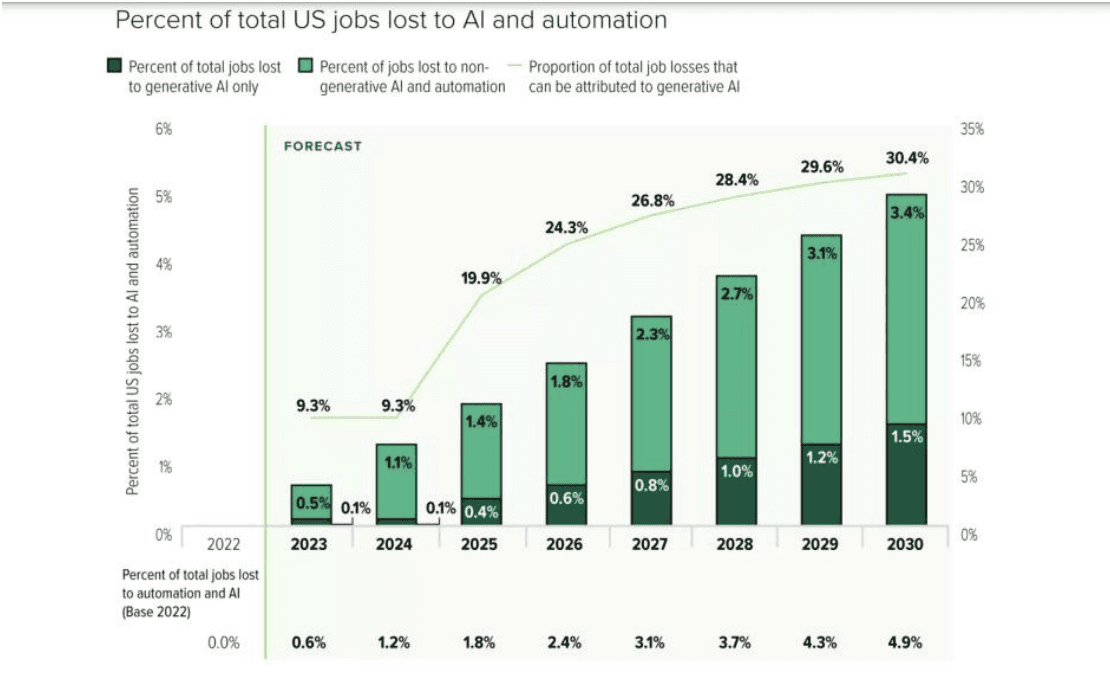
Fifth, coping with the effects of AI may require new federal spending. The budget surplus at the end of the Clinton Administration that stemmed from the communications technology boom gave the government substantial capability to address needs. Currently, however, the federal government faces a deficit issue of some magnitude. Moreover, the last reconciliation bill is estimated by the Congressional Budget Office to increase federal debt by $3.4 trillion over the next ten years. Some Congress and some Administration will need to address this issue.
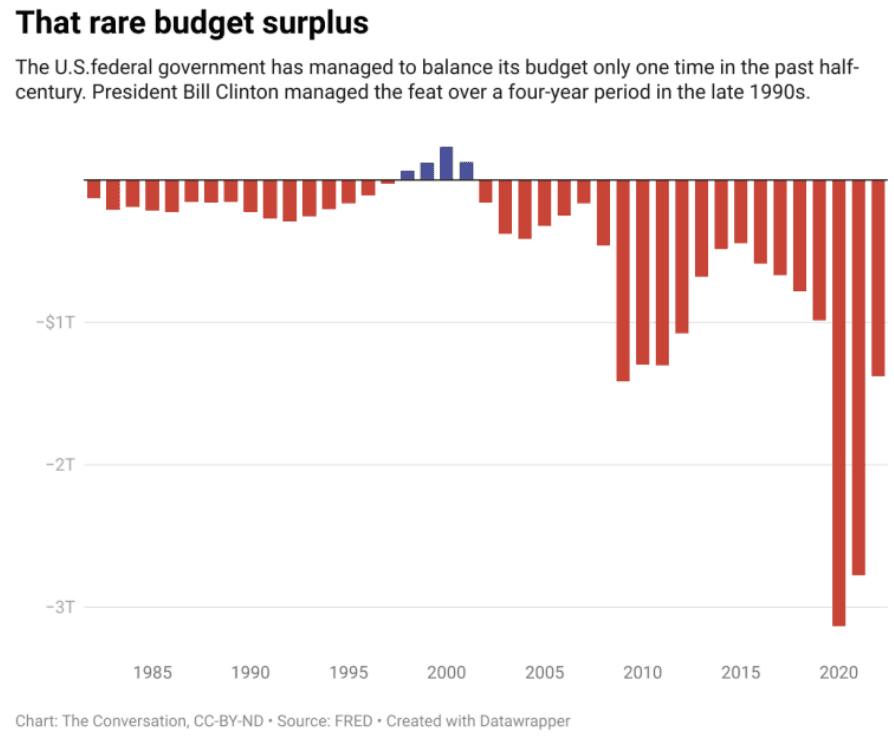
Sixth, antitrust is a topic that mattered in the 1990s and is likely to matter with respect to AI. In the 1990s radio, telephony, and other industries went through dramatic consolidation. The question of how many major wireless firms should compose the American market occupied antitrust authorities for many years. Currently AI-based firms are numerous in many markets. Not all will survive. Either a new agency or an existing agency should apply prudent antitrust policy to the inevitable consolidation.
Part of the shakeout will involve access to data centers with their vast array of server chips and banks of memory. The 90s teaches that government should not intervene prematurely to address what may appear to be bottlenecks. But neither should government be unaware or unconcerned with consolidation that stifles entrepreneurship and innovation. As previous pages have shown, the strategy three decades ago was to open bottlenecks where competition could flourish. This should guide government actions as AI expands its scope and scale.
Seventh, many new technologies create major infrastructure issues. The FCC's plan for the rollout of digital cellular included pre-emption of state regulation and the support of national networks that shared cell towers. These new objects in the landscape were not welcomed by all communities, but because tower companies (a new creation in communications) carried multiple antennas the number of towers was smaller than it might have been. The infrastructure issue for AI is data centers.
Electricity could be provided to data centers more quickly and more cheaply if the national government had a plan similar to the one we had for the roll-out of cellular networks. The plan could lead to a law and the delegation of regulatory power that would expedite new generation, interconnection to the grids, and provision of cheap power to data centers. An auction might be held to make desirable sites available with the funds used to allay negative impacts on communities.
Eighth, what about China? This question has been asked by Western powers for about two centuries. Our answer in the 90s was to bring China into the global rules-based framework of fair, tariff-free competition. Currencies should be fairly valued, and trade should flourish in accordance with Ricardo's ancient insights about comparative advantage. It was especially important to impose World Trade Organization rules, with potential sanctions, on a large and authoritarian economy like China's.
All our plans back in the 90s had an international component. By treaty, by creating international nonprofit, by trade deals, by global advocacy, we wanted to create a huge boon for everyone, and have that uplift translate into democracy, freedom and peace. We wanted to open China not just to exports but to a rule of law.
Our plans in the 90s for China were not fulfilled by succeeding Administrations. The global war on terror drove China far off the agenda. A different region - one where, as Milton put it, "armies whole were sunk; and in the deep/No bottom found" - received American attention, money, and blood. The attempt to restate a China policy in the 2010s was limited by the after- effects of the 2008 crisis bequeathed by that same Administration and by the surge in partisan politics that still plagues the United States.
The lesson of the 90s, however, is that with respect to China a strategy is not optional. It is imperative. Beijing always has one. It is constantly updated. It is not designed to benefit the West. Meeting that plan with no plan, or at least no good plan, is not ideal.
Nine, to realize the benefits of AI firms will need to distribute - sell - solutions. We saw that the Internet's benefits would not be widely available in schools and libraries unless we acted. That was the reason for the E Rate program. AI benefits too will not likely be available to all unless the federal and state governments create programs like the E Rate.
Probably nine reasons for creating an agency are less than the complete case. The military ramifications, for example, add a powerful tenth reason. However, the will to create a government structural and functional response to AI has not yet emerged in Congress or the Executive Branch. Events are likely to make the AIC proposition irresistible, but drift and complacency could cost the country dearly.
Artificial intelligence has a long lineage but a staggeringly unknowable future. Our thirty years of learning about the communications technology revolution tells us that the changes are not likely to be either all glorious nor all horrific. They will be huge and mixed. Our experience teaches that the American people deserve a government commission - an institution - that will look out for them as AI changes the economy, society, and, perhaps, the definition of what it means to be human. This Commission will need to act - even by using AI tools - for democracy, for ethics, for goals that are good for all and not just some.
Footnotes
[1] I chaired the Federal Communications Commission from November 1993 to November 1997. All the actions recorded in this document were the work of teams. No one person acted alone. This essay too reflects excellent commentary and advice from many people, including without limitation Blair Levin, Gerry Waldron, Karen Kornbluh, Richard Tedlow, Tom Craft, Ira Fishman, Bill Kennard, and Greg Rosston. All errors of fact and judgment belong to the named author.
[2] Thucydides wrote: “The absence of romance in my history will, I fear, detract somewhat from its interest; but if it be judged useful by those inquirers who desire an exact knowledge of the past as an aid to the interpretation of the future, which in the course of human things must resemble it if it does not reflect it, I shall be content.”
[3] https://en.wikipedia.org/wiki/Federal_Communications_Commission_fines_of_The_Howard_Stern_Show
[4] The world wide web was created in 1989; the first smart phone was in 1994. It was knowable in 1992 what could happen, but not everyone had a good sense of what was possible and no one knew everything that proved possible.
[5] No one expressed the policy more simply or better than Karen Kornbluh at a Brooking conference: “I was Director of the Office of Legislative and Intergovernmental Affairs at the FCC in the 1990s and then the Treasury Department representative on President Clinton’s legendary Internet Policy Task Force. [We wanted] to make good on Al Gore’s promise that a girl from Carthage, Tennessee could access any book in Library of Congress.”
[6] Analog meant that the emf waves varied in strength and pitch to create an “analogy” of the original sound or picture. The receiving device, such as a television or a telephone, received the signal and then imitated it in the picture or the earpiece. When the information was digitized, meaning translated into ones and zeroes, each radio wave could convey more, and the receiving devices would manage it with microprocessors. To make a complicated story short, the microprocessor would turn the bits into sound and picture. That meant that the doubling of speed and capability of the microprocessor every two years (promised by Moore’s law and delivered by Moore’s company, Intel) would change and drive all media for the foreseeable future. Everything would quickly get better and cheaper. Not just new companies but whole new industries would change the world.
[7] A bit is the smallest measure of digital information. It is either a 1 or a 0.
[8] When the iMac was first introduced it was difficult for many people to set up the internet connection and the “I” suggested that Apple solved that problem. In a 1998 ad, Jeff Goldblum promoted the iMac by explaining: step 1 was plug in; step 2 was get connected automatically. And “there is no step 3.” The connection was through a telephone line, as discussed in this essay.
[9] This move alone could put into permanent decline state-owned monopoly long distance companies, just as would happen in the United States. Everyone in the global telephone industry understood clearly that the United States as the source of revenue and technological change had immense negotiating power. Our goal was to persuade the other countries that everyone would be better off if the benefits of the great digitization were shared everywhere.
[10] As diplomats we at the FCC had to learn there were limits to what we should demand. Philippines President Fernando Marcos told us that if we lowered the amount of incoming revenue from Filipino workers in the U.S. calling home by the amount we proposed his budget would not fund efforts to battle a communist insurgency on one of the main islands. He sat at the desk once used by William Howard Taft during the American colonial occupation of the island. Marcos had installed a computer keyboard in the drawer, showing that he was willing to let the internet in, but needed the money. Being as how we were still in the afterglow of the collapse of communism we agreed; watching authoritarian dictatorships thrive in Russia and China with complacency was part of American history only decades later.
[11] At the end of the century Time Warner gave half its value to AOL in one of the most disastrous mergers in business history. Time Warner owned cable, the medium for the Internet as everyone would know in just a few years. AOL’s dial-up service was doomed. Time Warner needed only to wait for the future to fall into its lap. But our policy was not to guarantee firms that they would win: it was to have whole ideas triumph. This can be argued to be a difference with the way things are in the 2020s.
[12] After two days we spotted apparent bidding collusion in one geographic market. Chairman Hundt called Republican Senator Ted Stevens and asked for advice. The Senator said he had seen the same thing happen when he sold offshore oil leases for the Interior Department in Eisenhower Administration and he knew what to do. His public letter to the FCC threatening inquiry broke up the conspiracy, if there was one, and the bidding recommenced with competitive vigor.
[13] This program was upheld by a unanimous Supreme Court in 2025 in Wisconsin Bell vs United States ex rel Heath.
[14] In 1997 Bill Gates, then either the world’s richest person or close to it, announced he would give internet access to everyone in Mississippi schools, known to be either the poorest or close to it in the United States. The FCC chair enjoyed telling Gates that job was done and he should provide the computers with Microsoft software instead. Gates did that and sent Hundt a thank you note.
[15] New York Tel combined with New England to create Nynex, then merged with Bell Atlantic, and bought GTE. Southwestern Bell acquired Bell South, Ameritech and Pacific Telesis.
[16] Global GDP was $31.6 trillion in 1997 and 32.7 trillion in 1999 in dollars. In the united States it was 8.3t in 1997 and 9.3 T in 1999. The former is a $1.1 growth; the latter, $1T.
[17] We had Chief Judge Avner Mikva of the D.C. Circuit meet with all our lawyers and advise them about the importance of showing the reasoning for rules in the decision itself and not just in the brief filed in Court. Our appellate lawyers possibly for the first time in FCC history thereafter were involved in drafting the rule. They greatly improved the agency record on appeal from the miserable coinflip of a fifty percent success rate that we inherited.
[18] The author apologizes to those who should be listed but due to the frailties of this scribe were not.
[19] Ambassador Kornbluh has continuously led thinking and policy on the topics of this essay. See, e.g., https://www.foreignaffairs.com/articles/world/2018-08-13/internets-lost-promise.
[20] It is noteworthy that the Trump 2025 effort is very successful in achieving its goals in part because it is so broad and ambitious.
[21] Perhaps Chairman Tom Wheeler’s 2015 net neutrality rule, using Title II as the basis of jurisdiction, could have enabled the FCC to block transmission of harmful social media content. Admittedly, the advocates of net neutrality wanted the FCC to bar such blocking. That rule was repealed by the first Trump Administration in 2017.
[22] Pew Research, November 20, 2025.
[23] Here is an example: entrepreneur Peter Thiel wrote in 2009: “I no longer believe that freedom and democracy are compatible.” He continued: “The 1920s were the last decade in American history during which one could be genuinely optimistic about politics. Since 1920, the vast increase in welfare beneficiaries and the extension of the franchise to women—two constituencies that are notoriously tough for libertarians— have rendered the notion of ‘capitalist democracy’ into an oxymoron.”
[24] Government should have a public, expert-driven, flexible strategic plan for every major technological change. The electrical stake is another one. Noah Smith argues that these three inventions will transform business and society: the lithium-ion battery, the rare-earth electric motor, and power electronics. Somewhere in government expertise should be gathered to assess the impacts, just as this essay has hazarded with respect to AI. One obvious example is that United States needs to gain reliable access to rare earth.